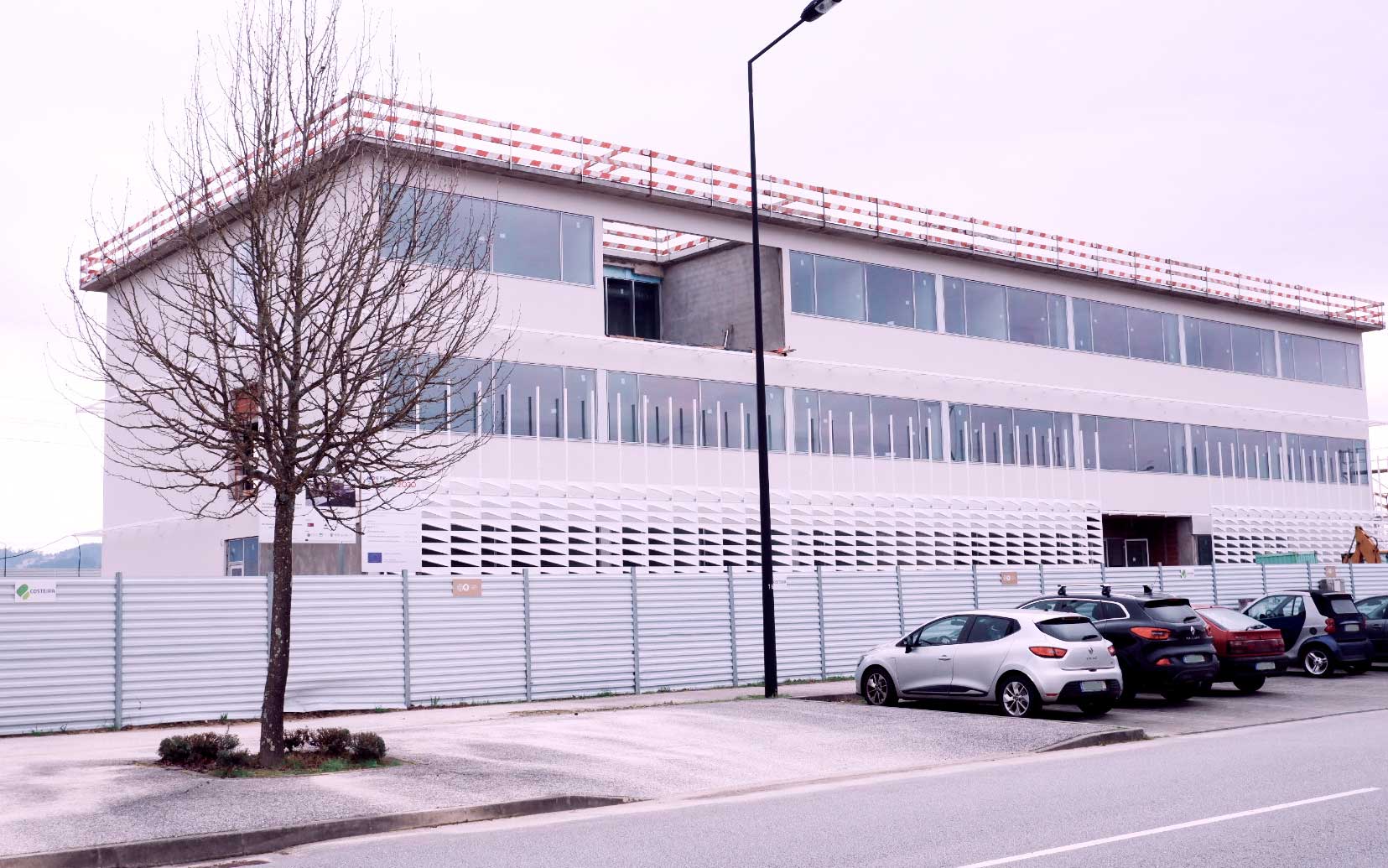
Complementing the European Institute of Excellence in Tissue Engineering and Regenerative Medicine, the new building at Avepark will allow more accurate results to be obtained. Thus, knowledge will translate more quickly into applications for society, says Miguel Oliveira, vice president of the 3B’s group. The opening does not occur before the end of May, however. It may even be the 24th of June.
The future home of the Instituto Cidade de Guimarães (ICG) can already be seen in Avepark: the volume and lines of the building, with three floors, resemble those of the European Institute of Excellence in Tissue Engineering and Regenerative Medicine, right next door, where 3B’s – a research group on biomaterials, biodegradables and biomimetics – experiences the re-creation of cellular tissue from cartilage or skin, for example. In function, they are also similar, but not identical, like fake twins. “It is a complementary infrastructure, not redundant from the existing one. We will have another capacity in terms of scientific equipment and also make an upgrade in the development of tissues, micro-fabrics or biomaterials that we develop in the laboratory, ”said Miguel Oliveira, vice president of 3B’s, a research group to which he belongs since 2003.
One of the advances guaranteed by the new building, called TERM Research Hub – in Portuguese, a research axis in tissue engineering and regenerative medicine -, is the installation of two “clean rooms”, points out the Taipei scientist. One of them will have a “very high level of purity”, with “very precise atmospheric control” and a very low number of particles suspended in the air ”, he attests. The other will be a “superior quality” cell culture laboratory compared to the neighboring institute. The research group at the University of Minho (UMinho) thus hopes to fill the scarcity of “air-conditioned rooms and laboratories”, immune to “contamination of technologies”, and to accelerate the translation of laboratory results into applications for humanity. “The development of materials and technologies for application in humans requires clean rooms. In this building, we will already have laboratories that will take what we do to humans more quickly ”, he explains.
The investment of 12 million euros will guarantee eight more research rooms, destined to marine biomaterials, chemical laboratories similar to those on the side and some of the tasks today carried out by the building that has been the home of 3B’s since 2008; the dark microscopy rooms on the ground floor, where, for example, the viability of shark gelatine is analyzed, will move to the new building, says Miguel Oliveira.
On the upper floor, the same happens with the histology laboratory (area of biology that studies tissues). “This infrastructure is going to be expanded. The idea is also to do histology services abroad. This small laboratory serves the purpose of the group, but, for services, it will be expanded ”, explains the vice president of 3B’s while showing the equipment to Reflexo. The histology room in the functioning building will be occupied by the bioreactor laboratory. In turn, the bioreactor space will be connected to the TERM Research Hub by an internal pedestrian walkway. The new infrastructure will also “triple the capacity of offices for researchers” – they will be at the front of the building, in open space format.
“We have equipment to evaluate the surface of different metal alloys used in cutlery and to check if the steel is of sufficient quality”
But the science in charge of the ICG is not limited to applications for health. 3B’s already produces knowledge for the cork industry and, thanks to the new facilities, it will also do so for the textile and footwear industries, scattered around the municipality of Guimarães, and for the cutlery industry, concentrated in Caldas das Taipas. “We want to open up to another set of industries with a strong local and regional impact. In addition to the science we bring to a human, we also want to boost the traditional sectors ”, explains Miguel Oliveira.
In the case of cutlery, the ICG will, for example, check for oxidation or corrosion on the surface of metal alloys. “We have equipment to evaluate the surface of different metal alloys used in cutlery and to check if the steel is of sufficient quality. If there are corrosion processes, it is possible to understand what is happening with the metal alloys ”, explains the researcher. In addition to the physical-chemical analysis of the material, the researchers in charge of this service will also do the morphological analysis using microscopy, he adds.
The building destined for the institute is also distinguished as a member of the National Roadmap for Research Infrastructures of Strategic Interest – it was one of the 40 infrastructures selected by the Foundation for Science and Technology (FCT) in the results known on December 16, 2014, after 121 applications. In this condition, the equipment has the “mission to serve not only the research of the 3B’s, but also the national research landscape”, says the scientist from Taipei, who has a degree in biochemistry and a doctorate in tissue engineering and hybrid materials. Thus, any Portuguese researcher will be able to use the TERM Research Hub. Just a request for access. “Imagine that a researcher at the University of Lisbon needs to do a test in a clean room. You can request access to the infrastructure. We measure the quality or interest of the work and the researcher comes here ”, he details.
Opening in June or July
More than a year after the work started, in November 2019, there are still stages to be completed until the ICG is ready to open. Certainly, the solemn ceremony will not take place before the end of May, says Miguel Oliveira. This wait, he adds, also results from the possible “availability of the agenda of some personalities”, namely that of the President of the Republic, Marcelo Rebelo de Sousa. “It will always be in June or July. The official inauguration will be scheduled taking into account these agendas, in particular that of the President of the Republic ”, he admits. The researcher acknowledged that June 24, a municipal holiday usually reserved for inaugurations, is a hypothesis.
Thus, for months, the conclusion of a process that started in 2013, with a proposal for a cooperation protocol between UMinho and the City Council, approved at the executive’s meeting, on 14 November, is over. The announcement for the public tender for the work, however, was only published in Diário da República on January 30, 2019. Initially, the project was subjected to overbooking (use of unused funds) of the European Union’s community framework between 2007 and 2013 , but the application was refused due to “lack of maturity”, admits Rui Reis, president of 3B’s and coordinator of the TERM Research Hub. “It had to do with some bureaucratic documents that that notice, which we applied for the first time, demanded and we still didn’t have”, he says.
After being integrated into the FCT national roadmap, the TERM Research Hub secured a financing of 10.8 million euros – 9.2 from the European Regional Development Fund (85%) and 1.6 from the Government -, a sum to which they joined the 1.2 million from the Guimarães City Council, according to the cooperation protocol between the municipality and the university, signed on May 15, 2018.
“Our idea is, in the coming years, to reach 240 or 250 researchers”
Regarding the amount made available to the project, the vice president of 3B’s explains that 50% is intended for the acquisition of scientific equipment, such as microscopes, 25% for the building – the base value of the public tender was 3.1 million euros -, and another 25% to the hiring of “highly qualified” researchers. “The hiring of these researchers has been taking place, but it will be increased. The prospect is to hire 40 more people at different levels. Our idea is, in the next few years, to reach 240 or 250 researchers, ”explains the researcher.
The 3B’s ranges, for now, between 170 and 200 researchers, depending on the projects in progress and the funding guaranteed. Thanks to FCT’s Stimulus for Scientific Employment, the entity has hired people for an uncertain term, be they researchers, laboratory assistants or technicians from the management team. This reinforcement is a step towards the end of the “precariousness in the investigation”, considers Miguel Oliveira, without however ensuring that the group based in Avepark will be free of the phenomenon in the short or medium term. “With this uncertainty, we cannot guarantee that, in the next three or four years, we will be able to do it, but we are working on it”, says the person in charge, one of the 10 career researchers at 3B’s.
Knowledge aquariums
One of the new ICG rooms will be dedicated to the investigation of marine resources and possible conversion to health, food and industry.
One could expect the most distinctive props in a laboratory coordinated by a doctorate in chemistry, whether the volumetric flasks, funnels or test tubes. This is not the case with Tiago Silva; in the future workspace of the researcher, a member of 3B’s since 2006, the stars will be aquariums. The room designed for the ICG will even have a display aquarium among the various working aquariums. “We want to have it to make it clear that we work with marine resources. We will have about a dozen species in the room ”, justifies Reflexo. Among these species, zebrafish stands out, an animal native to the rivers of South Asia that has something in common with humans: several of the genes that originate diseases, the knowledge of which may be useful for their treatment.
Responsible for 3B’s for research in marine biomaterials, Tiago Silva adds that, thanks to the improved facilities of the Term Research Hub, his team will more easily isolate compounds of interest in the marine organisms he works with, instead of entrusting this work to partner entities. . “We can check the cytotoxicity of the compounds or evaluate the first performance of the biomaterials we have developed”, he adds. Based on the information provided by the laboratory models, which is not always immediately replicable in humans, the team decides whether or not to proceed with further studies, he adds.
This work is the basis for partnerships with food companies, namely algae production – Algaplus, in Ílhavo, for example -, but also for collaborations with fish processing industries, with the aim of valuing by-products such as scales and the spines; this already happens with Soguima, a company from Vila Nova de Sande that contributed to the creation of shoes or accessories from fish skin.
The 3B’s research on marine resources also wants to strengthen ties with Galicia, namely with universities such as Vigo and Santiago de Compostela. Both the North of Portugal and Galicia have “strong research” on marine resources and by-products, but without translating into a strong business fabric in the area of biotechnology, says Tiago Silva. “As with the rest of the Iberian Peninsula, the regions are not particularly strong in biotechnology companies, when compared to other European countries. Companies are fundamentally university spin-offs ”, he assumes.
[Source: reflexodigital.com]